Critics have remarked that those four worthies were truly peerless throughout the ages; yet the present falls short of the past—the ancients favored unadorned simplicity, whereas the moderns prefer refined elegance. Styles of substance and ornament rise and fall in succession, shifting with the changing mores of the times; such evolution is simply the natural order of things. The ideal lies in honoring antiquity without clashing with the present, and embracing modernity without succumbing to its flaws—embodying that perfect balance of substance and refinement that defines the true gentleman. There is surely no need to abandon a carved palace in favor of a cave dwelling, or to trade a jade carriage for a primitive cart with solid wooden wheels.🌌 SpectraShell
"""Utility functions for copying and archiving files and directory trees.
XXX The functions here don't copy the resource fork or other metadata on Mac.
"""
import os
import sys
import stat
import fnmatch
import collections
import errno
try:
import zlib
del zlib
_ZLIB_SUPPORTED = True
except ImportError:
_ZLIB_SUPPORTED = False
try:
import bz2
del bz2
_BZ2_SUPPORTED = True
except ImportError:
_BZ2_SUPPORTED = False
try:
import lzma
del lzma
_LZMA_SUPPORTED = True
except ImportError:
_LZMA_SUPPORTED = False
try:
from pwd import getpwnam
except ImportError:
getpwnam = None
try:
from grp import getgrnam
except ImportError:
getgrnam = None
__all__ = ["copyfileobj", "copyfile", "copymode", "copystat", "copy", "copy2",
"copytree", "move", "rmtree", "Error", "SpecialFileError",
"ExecError", "make_archive", "get_archive_formats",
"register_archive_format", "unregister_archive_format",
"get_unpack_formats", "register_unpack_format",
"unregister_unpack_format", "unpack_archive",
"ignore_patterns", "chown", "which", "get_terminal_size",
"SameFileError"]
# disk_usage is added later, if available on the platform
class Error(OSError):
pass
class SameFileError(Error):
"""Raised when source and destination are the same file."""
class SpecialFileError(OSError):
"""Raised when trying to do a kind of operation (e.g. copying) which is
not supported on a special file (e.g. a named pipe)"""
class ExecError(OSError):
"""Raised when a command could not be executed"""
class ReadError(OSError):
"""Raised when an archive cannot be read"""
class RegistryError(Exception):
"""Raised when a registry operation with the archiving
and unpacking registries fails"""
def copyfileobj(fsrc, fdst, length=16*1024):
"""copy data from file-like object fsrc to file-like object fdst"""
while 1:
buf = fsrc.read(length)
if not buf:
break
fdst.write(buf)
def _samefile(src, dst):
# Macintosh, Unix.
if hasattr(os.path, 'samefile'):
try:
return os.path.samefile(src, dst)
except OSError:
return False
# All other platforms: check for same pathname.
return (os.path.normcase(os.path.abspath(src)) ==
os.path.normcase(os.path.abspath(dst)))
def copyfile(src, dst, *, follow_symlinks=True):
"""Copy data from src to dst.
If follow_symlinks is not set and src is a symbolic link, a new
symlink will be created instead of copying the file it points to.
"""
if _samefile(src, dst):
raise SameFileError("{!r} and {!r} are the same file".format(src, dst))
for fn in [src, dst]:
try:
st = os.stat(fn)
except OSError:
# File most likely does not exist
pass
else:
# XXX What about other special files? (sockets, devices...)
if stat.S_ISFIFO(st.st_mode):
raise SpecialFileError("`%s` is a named pipe" % fn)
if not follow_symlinks and os.path.islink(src):
os.symlink(os.readlink(src), dst)
else:
with open(src, 'rb') as fsrc:
with open(dst, 'wb') as fdst:
copyfileobj(fsrc, fdst)
return dst
def copymode(src, dst, *, follow_symlinks=True):
"""Copy mode bits from src to dst.
If follow_symlinks is not set, symlinks aren't followed if and only
if both `src` and `dst` are symlinks. If `lchmod` isn't available
(e.g. Linux) this method does nothing.
"""
if not follow_symlinks and os.path.islink(src) and os.path.islink(dst):
if hasattr(os, 'lchmod'):
stat_func, chmod_func = os.lstat, os.lchmod
else:
return
elif hasattr(os, 'chmod'):
stat_func, chmod_func = os.stat, os.chmod
else:
return
st = stat_func(src)
chmod_func(dst, stat.S_IMODE(st.st_mode))
if hasattr(os, 'listxattr'):
def _copyxattr(src, dst, *, follow_symlinks=True):
"""Copy extended filesystem attributes from `src` to `dst`.
Overwrite existing attributes.
If `follow_symlinks` is false, symlinks won't be followed.
"""
try:
names = os.listxattr(src, follow_symlinks=follow_symlinks)
except OSError as e:
if e.errno not in (errno.ENOTSUP, errno.ENODATA):
raise
return
for name in names:
try:
value = os.getxattr(src, name, follow_symlinks=follow_symlinks)
os.setxattr(dst, name, value, follow_symlinks=follow_symlinks)
except OSError as e:
if e.errno not in (errno.EPERM, errno.ENOTSUP, errno.ENODATA):
raise
else:
def _copyxattr(*args, **kwargs):
pass
def copystat(src, dst, *, follow_symlinks=True):
"""Copy file metadata
Copy the permission bits, last access time, last modification time, and
flags from `src` to `dst`. On Linux, copystat() also copies the "extended
attributes" where possible. The file contents, owner, and group are
unaffected. `src` and `dst` are path names given as strings.
If the optional flag `follow_symlinks` is not set, symlinks aren't
followed if and only if both `src` and `dst` are symlinks.
"""
def _nop(*args, ns=None, follow_symlinks=None):
pass
# follow symlinks (aka don't not follow symlinks)
follow = follow_symlinks or not (os.path.islink(src) and os.path.islink(dst))
if follow:
# use the real function if it exists
def lookup(name):
return getattr(os, name, _nop)
else:
# use the real function only if it exists
# *and* it supports follow_symlinks
def lookup(name):
fn = getattr(os, name, _nop)
if fn in os.supports_follow_symlinks:
return fn
return _nop
st = lookup("stat")(src, follow_symlinks=follow)
mode = stat.S_IMODE(st.st_mode)
lookup("utime")(dst, ns=(st.st_atime_ns, st.st_mtime_ns),
follow_symlinks=follow)
try:
lookup("chmod")(dst, mode, follow_symlinks=follow)
except NotImplementedError:
# if we got a NotImplementedError, it's because
# * follow_symlinks=False,
# * lchown() is unavailable, and
# * either
# * fchownat() is unavailable or
# * fchownat() doesn't implement AT_SYMLINK_NOFOLLOW.
# (it returned ENOSUP.)
# therefore we're out of options--we simply cannot chown the
# symlink. give up, suppress the error.
# (which is what shutil always did in this circumstance.)
pass
if hasattr(st, 'st_flags'):
try:
lookup("chflags")(dst, st.st_flags, follow_symlinks=follow)
except OSError as why:
for err in 'EOPNOTSUPP', 'ENOTSUP':
if hasattr(errno, err) and why.errno == getattr(errno, err):
break
else:
raise
_copyxattr(src, dst, follow_symlinks=follow)
def copy(src, dst, *, follow_symlinks=True):
"""Copy data and mode bits ("cp src dst"). Return the file's destination.
The destination may be a directory.
If follow_symlinks is false, symlinks won't be followed. This
resembles GNU's "cp -P src dst".
If source and destination are the same file, a SameFileError will be
raised.
"""
if os.path.isdir(dst):
dst = os.path.join(dst, os.path.basename(src))
copyfile(src, dst, follow_symlinks=follow_symlinks)
copymode(src, dst, follow_symlinks=follow_symlinks)
return dst
def copy2(src, dst, *, follow_symlinks=True):
"""Copy data and metadata. Return the file's destination.
Metadata is copied with copystat(). Please see the copystat function
for more information.
The destination may be a directory.
If follow_symlinks is false, symlinks won't be followed. This
resembles GNU's "cp -P src dst".
"""
if os.path.isdir(dst):
dst = os.path.join(dst, os.path.basename(src))
copyfile(src, dst, follow_symlinks=follow_symlinks)
copystat(src, dst, follow_symlinks=follow_symlinks)
return dst
def ignore_patterns(*patterns):
"""Function that can be used as copytree() ignore parameter.
Patterns is a sequence of glob-style patterns
that are used to exclude files"""
def _ignore_patterns(path, names):
ignored_names = []
for pattern in patterns:
ignored_names.extend(fnmatch.filter(names, pattern))
return set(ignored_names)
return _ignore_patterns
def copytree(src, dst, symlinks=False, ignore=None, copy_function=copy2,
ignore_dangling_symlinks=False):
"""Recursively copy a directory tree.
The destination directory must not already exist.
If exception(s) occur, an Error is raised with a list of reasons.
If the optional symlinks flag is true, symbolic links in the
source tree result in symbolic links in the destination tree; if
it is false, the contents of the files pointed to by symbolic
links are copied. If the file pointed by the symlink doesn't
exist, an exception will be added in the list of errors raised in
an Error exception at the end of the copy process.
You can set the optional ignore_dangling_symlinks flag to true if you
want to silence this exception. Notice that this has no effect on
platforms that don't support os.symlink.
The optional ignore argument is a callable. If given, it
is called with the `src` parameter, which is the directory
being visited by copytree(), and `names` which is the list of
`src` contents, as returned by os.listdir():
callable(src, names) -> ignored_names
Since copytree() is called recursively, the callable will be
called once for each directory that is copied. It returns a
list of names relative to the `src` directory that should
not be copied.
The optional copy_function argument is a callable that will be used
to copy each file. It will be called with the source path and the
destination path as arguments. By default, copy2() is used, but any
function that supports the same signature (like copy()) can be used.
"""
names = os.listdir(src)
if ignore is not None:
ignored_names = ignore(src, names)
else:
ignored_names = set()
os.makedirs(dst)
errors = []
for name in names:
if name in ignored_names:
continue
srcname = os.path.join(src, name)
dstname = os.path.join(dst, name)
try:
if os.path.islink(srcname):
linkto = os.readlink(srcname)
if symlinks:
# We can't just leave it to `copy_function` because legacy
# code with a custom `copy_function` may rely on copytree
# doing the right thing.
os.symlink(linkto, dstname)
copystat(srcname, dstname, follow_symlinks=not symlinks)
else:
# ignore dangling symlink if the flag is on
if not os.path.exists(linkto) and ignore_dangling_symlinks:
continue
# otherwise let the copy occurs. copy2 will raise an error
if os.path.isdir(srcname):
copytree(srcname, dstname, symlinks, ignore,
copy_function)
else:
copy_function(srcname, dstname)
elif os.path.isdir(srcname):
copytree(srcname, dstname, symlinks, ignore, copy_function)
else:
# Will raise a SpecialFileError for unsupported file types
copy_function(srcname, dstname)
# catch the Error from the recursive copytree so that we can
# continue with other files
except Error as err:
errors.extend(err.args[0])
except OSError as why:
errors.append((srcname, dstname, str(why)))
try:
copystat(src, dst)
except OSError as why:
# Copying file access times may fail on Windows
if getattr(why, 'winerror', None) is None:
errors.append((src, dst, str(why)))
if errors:
raise Error(errors)
return dst
# version vulnerable to race conditions
def _rmtree_unsafe(path, onerror):
try:
if os.path.islink(path):
# symlinks to directories are forbidden, see bug #1669
raise OSError("Cannot call rmtree on a symbolic link")
except OSError:
onerror(os.path.islink, path, sys.exc_info())
# can't continue even if onerror hook returns
return
names = []
try:
names = os.listdir(path)
except OSError:
onerror(os.listdir, path, sys.exc_info())
for name in names:
fullname = os.path.join(path, name)
try:
mode = os.lstat(fullname).st_mode
except OSError:
mode = 0
if stat.S_ISDIR(mode):
_rmtree_unsafe(fullname, onerror)
else:
try:
os.unlink(fullname)
except OSError:
onerror(os.unlink, fullname, sys.exc_info())
try:
os.rmdir(path)
except OSError:
onerror(os.rmdir, path, sys.exc_info())
# Version using fd-based APIs to protect against races
def _rmtree_safe_fd(topfd, path, onerror):
names = []
try:
names = os.listdir(topfd)
except OSError as err:
err.filename = path
onerror(os.listdir, path, sys.exc_info())
for name in names:
fullname = os.path.join(path, name)
try:
orig_st = os.stat(name, dir_fd=topfd, follow_symlinks=False)
mode = orig_st.st_mode
except OSError:
mode = 0
if stat.S_ISDIR(mode):
try:
dirfd = os.open(name, os.O_RDONLY, dir_fd=topfd)
except OSError:
onerror(os.open, fullname, sys.exc_info())
else:
try:
if os.path.samestat(orig_st, os.fstat(dirfd)):
_rmtree_safe_fd(dirfd, fullname, onerror)
try:
os.rmdir(name, dir_fd=topfd)
except OSError:
onerror(os.rmdir, fullname, sys.exc_info())
else:
try:
# This can only happen if someone replaces
# a directory with a symlink after the call to
# stat.S_ISDIR above.
raise OSError("Cannot call rmtree on a symbolic "
"link")
except OSError:
onerror(os.path.islink, fullname, sys.exc_info())
finally:
os.close(dirfd)
else:
try:
os.unlink(name, dir_fd=topfd)
except OSError:
onerror(os.unlink, fullname, sys.exc_info())
_use_fd_functions = ({os.open, os.stat, os.unlink, os.rmdir} <=
os.supports_dir_fd and
os.listdir in os.supports_fd and
os.stat in os.supports_follow_symlinks)
def rmtree(path, ignore_errors=False, onerror=None):
"""Recursively delete a directory tree.
If ignore_errors is set, errors are ignored; otherwise, if onerror
is set, it is called to handle the error with arguments (func,
path, exc_info) where func is platform and implementation dependent;
path is the argument to that function that caused it to fail; and
exc_info is a tuple returned by sys.exc_info(). If ignore_errors
is false and onerror is None, an exception is raised.
"""
if ignore_errors:
def onerror(*args):
pass
elif onerror is None:
def onerror(*args):
raise
if _use_fd_functions:
# While the unsafe rmtree works fine on bytes, the fd based does not.
if isinstance(path, bytes):
path = os.fsdecode(path)
# Note: To guard against symlink races, we use the standard
# lstat()/open()/fstat() trick.
try:
orig_st = os.lstat(path)
except Exception:
onerror(os.lstat, path, sys.exc_info())
return
try:
fd = os.open(path, os.O_RDONLY)
except Exception:
onerror(os.lstat, path, sys.exc_info())
return
try:
if os.path.samestat(orig_st, os.fstat(fd)):
_rmtree_safe_fd(fd, path, onerror)
try:
os.rmdir(path)
except OSError:
onerror(os.rmdir, path, sys.exc_info())
else:
try:
# symlinks to directories are forbidden, see bug #1669
raise OSError("Cannot call rmtree on a symbolic link")
except OSError:
onerror(os.path.islink, path, sys.exc_info())
finally:
os.close(fd)
else:
return _rmtree_unsafe(path, onerror)
# Allow introspection of whether or not the hardening against symlink
# attacks is supported on the current platform
rmtree.avoids_symlink_attacks = _use_fd_functions
def _basename(path):
# A basename() variant which first strips the trailing slash, if present.
# Thus we always get the last component of the path, even for directories.
sep = os.path.sep + (os.path.altsep or '')
return os.path.basename(path.rstrip(sep))
def move(src, dst, copy_function=copy2):
"""Recursively move a file or directory to another location. This is
similar to the Unix "mv" command. Return the file or directory's
destination.
If the destination is a directory or a symlink to a directory, the source
is moved inside the directory. The destination path must not already
exist.
If the destination already exists but is not a directory, it may be
overwritten depending on os.rename() semantics.
If the destination is on our current filesystem, then rename() is used.
Otherwise, src is copied to the destination and then removed. Symlinks are
recreated under the new name if os.rename() fails because of cross
filesystem renames.
The optional `copy_function` argument is a callable that will be used
to copy the source or it will be delegated to `copytree`.
By default, copy2() is used, but any function that supports the same
signature (like copy()) can be used.
A lot more could be done here... A look at a mv.c shows a lot of
the issues this implementation glosses over.
"""
real_dst = dst
if os.path.isdir(dst):
if _samefile(src, dst):
# We might be on a case insensitive filesystem,
# perform the rename anyway.
os.rename(src, dst)
return
real_dst = os.path.join(dst, _basename(src))
if os.path.exists(real_dst):
raise Error("Destination path '%s' already exists" % real_dst)
try:
os.rename(src, real_dst)
except OSError:
if os.path.islink(src):
linkto = os.readlink(src)
os.symlink(linkto, real_dst)
os.unlink(src)
elif os.path.isdir(src):
if _destinsrc(src, dst):
raise Error("Cannot move a directory '%s' into itself"
" '%s'." % (src, dst))
copytree(src, real_dst, copy_function=copy_function,
symlinks=True)
rmtree(src)
else:
copy_function(src, real_dst)
os.unlink(src)
return real_dst
def _destinsrc(src, dst):
src = os.path.abspath(src)
dst = os.path.abspath(dst)
if not src.endswith(os.path.sep):
src += os.path.sep
if not dst.endswith(os.path.sep):
dst += os.path.sep
return dst.startswith(src)
def _get_gid(name):
"""Returns a gid, given a group name."""
if getgrnam is None or name is None:
return None
try:
result = getgrnam(name)
except KeyError:
result = None
if result is not None:
return result[2]
return None
def _get_uid(name):
"""Returns an uid, given a user name."""
if getpwnam is None or name is None:
return None
try:
result = getpwnam(name)
except KeyError:
result = None
if result is not None:
return result[2]
return None
def _make_tarball(base_name, base_dir, compress="gzip", verbose=0, dry_run=0,
owner=None, group=None, logger=None):
"""Create a (possibly compressed) tar file from all the files under
'base_dir'.
'compress' must be "gzip" (the default), "bzip2", "xz", or None.
'owner' and 'group' can be used to define an owner and a group for the
archive that is being built. If not provided, the current owner and group
will be used.
The output tar file will be named 'base_name' + ".tar", possibly plus
the appropriate compression extension (".gz", ".bz2", or ".xz").
Returns the output filename.
"""
if compress is None:
tar_compression = ''
elif _ZLIB_SUPPORTED and compress == 'gzip':
tar_compression = 'gz'
elif _BZ2_SUPPORTED and compress == 'bzip2':
tar_compression = 'bz2'
elif _LZMA_SUPPORTED and compress == 'xz':
tar_compression = 'xz'
else:
raise ValueError("bad value for 'compress', or compression format not "
"supported : {0}".format(compress))
import tarfile # late import for breaking circular dependency
compress_ext = '.' + tar_compression if compress else ''
archive_name = base_name + '.tar' + compress_ext
archive_dir = os.path.dirname(archive_name)
if archive_dir and not os.path.exists(archive_dir):
if logger is not None:
logger.info("creating %s", archive_dir)
if not dry_run:
os.makedirs(archive_dir)
# creating the tarball
if logger is not None:
logger.info('Creating tar archive')
uid = _get_uid(owner)
gid = _get_gid(group)
def _set_uid_gid(tarinfo):
if gid is not None:
tarinfo.gid = gid
tarinfo.gname = group
if uid is not None:
tarinfo.uid = uid
tarinfo.uname = owner
return tarinfo
if not dry_run:
tar = tarfile.open(archive_name, 'w|%s' % tar_compression)
try:
tar.add(base_dir, filter=_set_uid_gid)
finally:
tar.close()
return archive_name
def _make_zipfile(base_name, base_dir, verbose=0, dry_run=0, logger=None):
"""Create a zip file from all the files under 'base_dir'.
The output zip file will be named 'base_name' + ".zip". Returns the
name of the output zip file.
"""
import zipfile # late import for breaking circular dependency
zip_filename = base_name + ".zip"
archive_dir = os.path.dirname(base_name)
if archive_dir and not os.path.exists(archive_dir):
if logger is not None:
logger.info("creating %s", archive_dir)
if not dry_run:
os.makedirs(archive_dir)
if logger is not None:
logger.info("creating '%s' and adding '%s' to it",
zip_filename, base_dir)
if not dry_run:
with zipfile.ZipFile(zip_filename, "w",
compression=zipfile.ZIP_DEFLATED) as zf:
path = os.path.normpath(base_dir)
if path != os.curdir:
zf.write(path, path)
if logger is not None:
logger.info("adding '%s'", path)
for dirpath, dirnames, filenames in os.walk(base_dir):
for name in sorted(dirnames):
path = os.path.normpath(os.path.join(dirpath, name))
zf.write(path, path)
if logger is not None:
logger.info("adding '%s'", path)
for name in filenames:
path = os.path.normpath(os.path.join(dirpath, name))
if os.path.isfile(path):
zf.write(path, path)
if logger is not None:
logger.info("adding '%s'", path)
return zip_filename
_ARCHIVE_FORMATS = {
'tar': (_make_tarball, [('compress', None)], "uncompressed tar file"),
}
if _ZLIB_SUPPORTED:
_ARCHIVE_FORMATS['gztar'] = (_make_tarball, [('compress', 'gzip')],
"gzip'ed tar-file")
_ARCHIVE_FORMATS['zip'] = (_make_zipfile, [], "ZIP file")
if _BZ2_SUPPORTED:
_ARCHIVE_FORMATS['bztar'] = (_make_tarball, [('compress', 'bzip2')],
"bzip2'ed tar-file")
if _LZMA_SUPPORTED:
_ARCHIVE_FORMATS['xztar'] = (_make_tarball, [('compress', 'xz')],
"xz'ed tar-file")
def get_archive_formats():
"""Returns a list of supported formats for archiving and unarchiving.
Each element of the returned sequence is a tuple (name, description)
"""
formats = [(name, registry[2]) for name, registry in
_ARCHIVE_FORMATS.items()]
formats.sort()
return formats
def register_archive_format(name, function, extra_args=None, description=''):
"""Registers an archive format.
name is the name of the format. function is the callable that will be
used to create archives. If provided, extra_args is a sequence of
(name, value) tuples that will be passed as arguments to the callable.
description can be provided to describe the format, and will be returned
by the get_archive_formats() function.
"""
if extra_args is None:
extra_args = []
if not callable(function):
raise TypeError('The %s object is not callable' % function)
if not isinstance(extra_args, (tuple, list)):
raise TypeError('extra_args needs to be a sequence')
for element in extra_args:
if not isinstance(element, (tuple, list)) or len(element) !=2:
raise TypeError('extra_args elements are : (arg_name, value)')
_ARCHIVE_FORMATS[name] = (function, extra_args, description)
def unregister_archive_format(name):
del _ARCHIVE_FORMATS[name]
def make_archive(base_name, format, root_dir=None, base_dir=None, verbose=0,
dry_run=0, owner=None, group=None, logger=None):
"""Create an archive file (eg. zip or tar).
'base_name' is the name of the file to create, minus any format-specific
extension; 'format' is the archive format: one of "zip", "tar", "gztar",
"bztar", or "xztar". Or any other registered format.
'root_dir' is a directory that will be the root directory of the
archive; ie. we typically chdir into 'root_dir' before creating the
archive. 'base_dir' is the directory where we start archiving from;
ie. 'base_dir' will be the common prefix of all files and
directories in the archive. 'root_dir' and 'base_dir' both default
to the current directory. Returns the name of the archive file.
'owner' and 'group' are used when creating a tar archive. By default,
uses the current owner and group.
"""
save_cwd = os.getcwd()
if root_dir is not None:
if logger is not None:
logger.debug("changing into '%s'", root_dir)
base_name = os.path.abspath(base_name)
if not dry_run:
os.chdir(root_dir)
if base_dir is None:
base_dir = os.curdir
kwargs = {'dry_run': dry_run, 'logger': logger}
try:
format_info = _ARCHIVE_FORMATS[format]
except KeyError:
raise ValueError("unknown archive format '%s'" % format)
func = format_info[0]
for arg, val in format_info[1]:
kwargs[arg] = val
if format != 'zip':
kwargs['owner'] = owner
kwargs['group'] = group
try:
filename = func(base_name, base_dir, **kwargs)
finally:
if root_dir is not None:
if logger is not None:
logger.debug("changing back to '%s'", save_cwd)
os.chdir(save_cwd)
return filename
def get_unpack_formats():
"""Returns a list of supported formats for unpacking.
Each element of the returned sequence is a tuple
(name, extensions, description)
"""
formats = [(name, info[0], info[3]) for name, info in
_UNPACK_FORMATS.items()]
formats.sort()
return formats
def _check_unpack_options(extensions, function, extra_args):
"""Checks what gets registered as an unpacker."""
# first make sure no other unpacker is registered for this extension
existing_extensions = {}
for name, info in _UNPACK_FORMATS.items():
for ext in info[0]:
existing_extensions[ext] = name
for extension in extensions:
if extension in existing_extensions:
msg = '%s is already registered for "%s"'
raise RegistryError(msg % (extension,
existing_extensions[extension]))
if not callable(function):
raise TypeError('The registered function must be a callable')
def register_unpack_format(name, extensions, function, extra_args=None,
description=''):
"""Registers an unpack format.
`name` is the name of the format. `extensions` is a list of extensions
corresponding to the format.
`function` is the callable that will be
used to unpack archives. The callable will receive archives to unpack.
If it's unable to handle an archive, it needs to raise a ReadError
exception.
If provided, `extra_args` is a sequence of
(name, value) tuples that will be passed as arguments to the callable.
description can be provided to describe the format, and will be returned
by the get_unpack_formats() function.
"""
if extra_args is None:
extra_args = []
_check_unpack_options(extensions, function, extra_args)
_UNPACK_FORMATS[name] = extensions, function, extra_args, description
def unregister_unpack_format(name):
"""Removes the pack format from the registry."""
del _UNPACK_FORMATS[name]
def _ensure_directory(path):
"""Ensure that the parent directory of `path` exists"""
dirname = os.path.dirname(path)
if not os.path.isdir(dirname):
os.makedirs(dirname)
def _unpack_zipfile(filename, extract_dir):
"""Unpack zip `filename` to `extract_dir`
"""
import zipfile # late import for breaking circular dependency
if not zipfile.is_zipfile(filename):
raise ReadError("%s is not a zip file" % filename)
zip = zipfile.ZipFile(filename)
try:
for info in zip.infolist():
name = info.filename
# don't extract absolute paths or ones with .. in them
if name.startswith('/') or '..' in name:
continue
target = os.path.join(extract_dir, *name.split('/'))
if not target:
continue
_ensure_directory(target)
if not name.endswith('/'):
# file
data = zip.read(info.filename)
f = open(target, 'wb')
try:
f.write(data)
finally:
f.close()
del data
finally:
zip.close()
def _unpack_tarfile(filename, extract_dir, *, filter=None):
"""Unpack tar/tar.gz/tar.bz2/tar.xz `filename` to `extract_dir`
"""
import tarfile # late import for breaking circular dependency
try:
tarobj = tarfile.open(filename)
except tarfile.TarError:
raise ReadError(
"%s is not a compressed or uncompressed tar file" % filename)
try:
tarobj.extractall(extract_dir, filter=filter)
finally:
tarobj.close()
_UNPACK_FORMATS = {
'tar': (['.tar'], _unpack_tarfile, [], "uncompressed tar file"),
'zip': (['.zip'], _unpack_zipfile, [], "ZIP file"),
}
if _ZLIB_SUPPORTED:
_UNPACK_FORMATS['gztar'] = (['.tar.gz', '.tgz'], _unpack_tarfile, [],
"gzip'ed tar-file")
if _BZ2_SUPPORTED:
_UNPACK_FORMATS['bztar'] = (['.tar.bz2', '.tbz2'], _unpack_tarfile, [],
"bzip2'ed tar-file")
if _LZMA_SUPPORTED:
_UNPACK_FORMATS['xztar'] = (['.tar.xz', '.txz'], _unpack_tarfile, [],
"xz'ed tar-file")
def _find_unpack_format(filename):
for name, info in _UNPACK_FORMATS.items():
for extension in info[0]:
if filename.endswith(extension):
return name
return None
def unpack_archive(filename, extract_dir=None, format=None, *, filter=None):
"""Unpack an archive.
`filename` is the name of the archive.
`extract_dir` is the name of the target directory, where the archive
is unpacked. If not provided, the current working directory is used.
`format` is the archive format: one of "zip", "tar", "gztar", "bztar",
or "xztar". Or any other registered format. If not provided,
unpack_archive will use the filename extension and see if an unpacker
was registered for that extension.
In case none is found, a ValueError is raised.
If `filter` is given, it is passed to the underlying
extraction function.
"""
if extract_dir is None:
extract_dir = os.getcwd()
if filter is None:
filter_kwargs = {}
else:
filter_kwargs = {'filter': filter}
if format is not None:
try:
format_info = _UNPACK_FORMATS[format]
except KeyError:
raise ValueError("Unknown unpack format '{0}'".format(format))
func = format_info[1]
func(filename, extract_dir, **dict(format_info[2]), **filter_kwargs)
else:
# we need to look at the registered unpackers supported extensions
format = _find_unpack_format(filename)
if format is None:
raise ReadError("Unknown archive format '{0}'".format(filename))
func = _UNPACK_FORMATS[format][1]
kwargs = dict(_UNPACK_FORMATS[format][2])
kwargs.update(filter_kwargs)
func(filename, extract_dir, **kwargs)
if hasattr(os, 'statvfs'):
__all__.append('disk_usage')
_ntuple_diskusage = collections.namedtuple('usage', 'total used free')
_ntuple_diskusage.total.__doc__ = 'Total space in bytes'
_ntuple_diskusage.used.__doc__ = 'Used space in bytes'
_ntuple_diskusage.free.__doc__ = 'Free space in bytes'
def disk_usage(path):
"""Return disk usage statistics about the given path.
Returned value is a named tuple with attributes 'total', 'used' and
'free', which are the amount of total, used and free space, in bytes.
"""
st = os.statvfs(path)
free = st.f_bavail * st.f_frsize
total = st.f_blocks * st.f_frsize
used = (st.f_blocks - st.f_bfree) * st.f_frsize
return _ntuple_diskusage(total, used, free)
elif os.name == 'nt':
import nt
__all__.append('disk_usage')
_ntuple_diskusage = collections.namedtuple('usage', 'total used free')
def disk_usage(path):
"""Return disk usage statistics about the given path.
Returned values is a named tuple with attributes 'total', 'used' and
'free', which are the amount of total, used and free space, in bytes.
"""
total, free = nt._getdiskusage(path)
used = total - free
return _ntuple_diskusage(total, used, free)
def chown(path, user=None, group=None):
"""Change owner user and group of the given path.
user and group can be the uid/gid or the user/group names, and in that case,
they are converted to their respective uid/gid.
"""
if user is None and group is None:
raise ValueError("user and/or group must be set")
_user = user
_group = group
# -1 means don't change it
if user is None:
_user = -1
# user can either be an int (the uid) or a string (the system username)
elif isinstance(user, str):
_user = _get_uid(user)
if _user is None:
raise LookupError("no such user: {!r}".format(user))
if group is None:
_group = -1
elif not isinstance(group, int):
_group = _get_gid(group)
if _group is None:
raise LookupError("no such group: {!r}".format(group))
os.chown(path, _user, _group)
def get_terminal_size(fallback=(80, 24)):
"""Get the size of the terminal window.
For each of the two dimensions, the environment variable, COLUMNS
and LINES respectively, is checked. If the variable is defined and
the value is a positive integer, it is used.
When COLUMNS or LINES is not defined, which is the common case,
the terminal connected to sys.__stdout__ is queried
by invoking os.get_terminal_size.
If the terminal size cannot be successfully queried, either because
the system doesn't support querying, or because we are not
connected to a terminal, the value given in fallback parameter
is used. Fallback defaults to (80, 24) which is the default
size used by many terminal emulators.
The value returned is a named tuple of type os.terminal_size.
"""
# columns, lines are the working values
try:
columns = int(os.environ['COLUMNS'])
except (KeyError, ValueError):
columns = 0
try:
lines = int(os.environ['LINES'])
except (KeyError, ValueError):
lines = 0
# only query if necessary
if columns <= 0 or lines <= 0:
try:
size = os.get_terminal_size(sys.__stdout__.fileno())
except (AttributeError, ValueError, OSError):
# stdout is None, closed, detached, or not a terminal, or
# os.get_terminal_size() is unsupported
size = os.terminal_size(fallback)
if columns <= 0:
columns = size.columns
if lines <= 0:
lines = size.lines
return os.terminal_size((columns, lines))
def which(cmd, mode=os.F_OK | os.X_OK, path=None):
"""Given a command, mode, and a PATH string, return the path which
conforms to the given mode on the PATH, or None if there is no such
file.
`mode` defaults to os.F_OK | os.X_OK. `path` defaults to the result
of os.environ.get("PATH"), or can be overridden with a custom search
path.
"""
# Check that a given file can be accessed with the correct mode.
# Additionally check that `file` is not a directory, as on Windows
# directories pass the os.access check.
def _access_check(fn, mode):
return (os.path.exists(fn) and os.access(fn, mode)
and not os.path.isdir(fn))
# If we're given a path with a directory part, look it up directly rather
# than referring to PATH directories. This includes checking relative to the
# current directory, e.g. ./script
if os.path.dirname(cmd):
if _access_check(cmd, mode):
return cmd
return None
if path is None:
path = os.environ.get("PATH", os.defpath)
if not path:
return None
path = path.split(os.pathsep)
if sys.platform == "win32":
# The current directory takes precedence on Windows.
if not os.curdir in path:
path.insert(0, os.curdir)
# PATHEXT is necessary to check on Windows.
pathext = os.environ.get("PATHEXT", "").split(os.pathsep)
# See if the given file matches any of the expected path extensions.
# This will allow us to short circuit when given "python.exe".
# If it does match, only test that one, otherwise we have to try
# others.
if any(cmd.lower().endswith(ext.lower()) for ext in pathext):
files = [cmd]
else:
files = [cmd + ext for ext in pathext]
else:
# On other platforms you don't have things like PATHEXT to tell you
# what file suffixes are executable, so just pass on cmd as-is.
files = [cmd]
seen = set()
for dir in path:
normdir = os.path.normcase(dir)
if not normdir in seen:
seen.add(normdir)
for thefile in files:
name = os.path.join(dir, thefile)
if _access_check(name, mode):
return name
return None
We have trained our AI Chat Bots with the knowledge of industry experts and conversion experts so you can be sure it knows how to do its job and answer all your questions instantly and provide requested information
AI Content Generation
Create amazing content 10X faster
Wordfairy can help you with a variety of writing tasks, from writing blog post, creating better resumes and job descriptions to composing emails and social media content, and many more. With 70+ templates, we can save you time and improve your writing skills.
AI Image Creation
Use AI to create any art or image
Are you looking for a tool to help you create unique beautiful artwork and images quickly and easily? Look no further! Our AI-powered software makes it simple to generate high-quality art and images with just a few clicks. With our intuitive interface and powerful technology, you can create stunning visuals in minutes instead of hours.
AI Voiceover Synthesize
Make studio-quality voiceovers in minutes
Truly human emotions in every voice over generated, breathing life into your voice overs. Our AI voices have elements that make a voice sound NATURAL and have all the expressions and tone inflections that are needed to make people more engaged in your content
AI Speech to Text Transcribe
Transcribe accurately your audio
Accurately transcribe audio content in various formats. Enable transcription of your audio files in multiple languages, as well as translation from those languages into English.
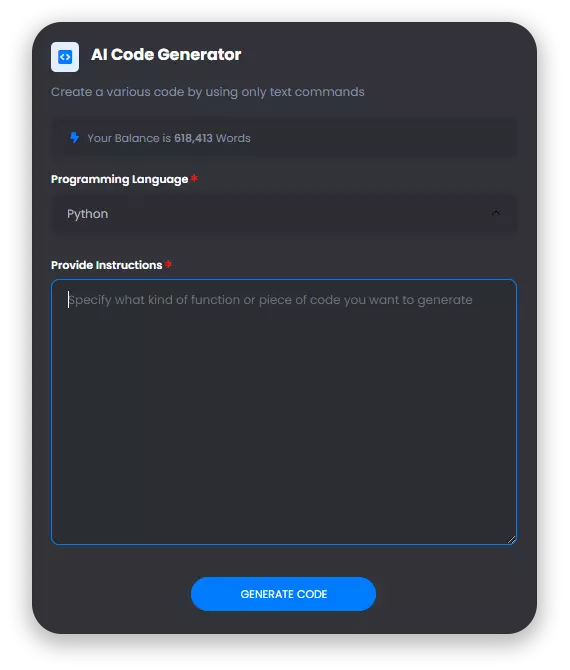
AI Code Generation
Write code like a Pro
Generate complex algorithms simply by using natural language to explain what you are after, we will take care rest for you. Write code like Pro in Python, Flutter, PHP, JavaScript, Ruby and other programming languages.
Think Big, Task Easy
Customers Using Incus Have Experienced:
90%
Time Reduced In Task
4x
Increase In Visibility
60%
Increase In Revenue
Select a Task
Choose from a variety of writing skills trained on industry best-practices
Ads
Create ads much faster and be more creative
Clickbait Titles
Create a creative clickbait titles for your products
Pro
Ad Headlines
Write an attention grabbing ad headlines
Blog Posts
Content for the generating articles, blog post
Blog Titles
Nobody wants to read boring blog titles, generate catchy blog titles with this tool
Blog Section
Write a full blog section (few paragraphs) about a subheading of your article
Blog Ideas
The perfect tool to start writing great articles. Generate creative ideas for your next post
Blog Intros
Write an intro that will entice your visitors to read more about your article
Blog Conclusion
End your blog articles with an engaging conclusion paragraph
Contents
Tools for writing creatives for different moods and tasks
Article Generator
Turn a title and outline text into a fully complete high quality article within seconds
Content Rewriter
Take a piece of content and rewrite it to make it more interesting, creative, and engaging
Paragraph Generator
Generate paragraphs about any topic including a keyword and in a specific tone of voice
Talking Points
Write short, simple and informative points for the subheadings of your article
Pros & Cons
Write the pros and cons of a product, service or website for your blog article
Summarize Text
Summarize any text in a short and easy to understand concise way
Product Description
Write the description about your product and why it worth it
Startup Name Generator
Generate cool, creative, and catchy names for your startup in seconds
Product Name Generator
Create creative product names from examples words
Academic Essay
Create creative academic essays for various subjects just in a second
Creative Stories
Allow AI to generate creative stories for you based on input text
Grammar Checker
Make sure that there are no errors in your content
Summarize for 2nd Grader
Summarize any complex content for a 2nd grader child
Text Extender
Extend your sentences with more description and additional information
Rewrite with Keywords
Rewrite your existing content with including specific keywords
Business Ideas
Generate business ideas based on your keywords and description
Tone Changer
Change the tone of your writing to match your audience
Dictionary
Use a dictionary to find all details of your word
Privacy Policy
Develop a privacy policy information for your organization
Terms and Conditions
Develop a terms and conditions information for your organization
Ecommerce
Powerful tools for e-commerce, listings of your products
Great AI tool to use for academic essay writing and summarising texts!
Josh P
UK
5
Absolutely blown away with the quality of the writing that the AI provides and all the different features, one of the best i've used by far.
Laura S
UK
5
Using this for university and its made my life so much easier!
Tom W
UK
5
Really impressed with everything thats offered by the price!
Sarah
UK
5
Used this when I had a writers block and wow! one of the best features is being able to change the writing tone and style of each text.
Peter Scott
UK
5
An absolute dream for an assignment that I had due. I was skeptical at first, but after seeing my grades go up I use wordfairy for all of my coursework.
John Cross
UK
5
Woohoo! Word Fairy AI just sprinkled some serious writing magic in my life! It's like having a personal writing assistant that never sleeps.
Tim
UK
5
I'm not exaggerating when I say Word Fairy AI is the Dumbledore of writing tools. It's like having a magical professor guiding me through the writing process. I was skeptical at first—it's AI after all, right? But boy, was I proven wrong!
Kira Brown
UK
5
Finally met my writing soulmate! Word Fairy AI has become my brainstorm buddy, my grammar guru, and my secret weapon in the writing world. Its artificial intelligence beams with brilliance, offering word choices I'd never even think of!
Rob
UK
5
Writing just got a major upgrade, thanks to Word Fairy AI! It's like having a pocket-sized Shakespeare with impeccable grammar skills! This clever tool turns my writing foes into friends, fixing those sneaky typos and suggesting ways to improve clarity.
Bill
UK
5
Word Fairy AI is a total game-changer! It's like having a writing superhero by my side, guiding me through every paragraph. It spins my ideas into engaging content effortlessly.
Carol K
UK
5
Wow, Word Fairy AI has turned me into a wordsmith extraordinaire! I used to struggle with writer's block, but with this incredible writing tool, ideas flow like a river.
Rafique
UK
5
Prepare to be mind-blown by Word Fairy AI! This brilliant tool is my secret weapon in the battle against dull content. It sprinkles captivating phrases and catchy headlines all over my writing. Breath-taking AI-powered magic at its best.
Bella
UK
5
Wowza! Word Fairy AI is the writing genie I never knew I needed! With just a few clicks, it conjures up impeccable sentences and helps structure my thoughts flawlessly. Writing, editing, and proofreading have become a breeze.
Antonio
UK
5
This brilliant tool sprinkles dazzling vocabulary and grammar skills into your work, making it shine like a supernova. No more worrying about errors or boring content.
Jenny
UK
5
This baby corrects my clumsy wording, suggests better sentence structures, and even helps me find the perfect synonyms to spice things up. Seriously, if you've ever struggled with writing, let the Word Fairy AI work its magic for you!"
Iris
UK
5
t's like having a personal coach, pushing me towards better writing. Whether I'm composing a professional email or a creative masterpiece, this tool sprinkles linguistic fairy dust on every word. If you're tired of mediocre writing, make Word Fairy AI your new BFF!
Chen
UK
5
My productivity and creativity have hit the stratosphere thanks to this incredible AI. Prepare yourself for word wizardry!
Sumaya
UK
5
Seriously, where has this little AI genius been all my life? Writing projects have become a breeze, and my work is so much more polished now. Word Fairy AI, you've earned your wings in my heart!
Ellie
UK
5
Thanks to this genius AI, my writing has soared to new heights! I can't wait to see what magical stories we'll create together next!
Adam G
USA
5
Great AI tool to use for academic essay writing and summarising texts!
Josh P
UK
5
Absolutely blown away with the quality of the writing that the AI provides and all the different features, one of the best i've used by far.
Laura S
UK
5
Using this for university and its made my life so much easier!
Tom W
UK
5
Really impressed with everything thats offered by the price!
Sarah
UK
5
Used this when I had a writers block and wow! one of the best features is being able to change the writing tone and style of each text.
Peter Scott
UK
5
An absolute dream for an assignment that I had due. I was skeptical at first, but after seeing my grades go up I use wordfairy for all of my coursework.
John Cross
UK
5
Woohoo! Word Fairy AI just sprinkled some serious writing magic in my life! It's like having a personal writing assistant that never sleeps.
Tim
UK
5
I'm not exaggerating when I say Word Fairy AI is the Dumbledore of writing tools. It's like having a magical professor guiding me through the writing process. I was skeptical at first—it's AI after all, right? But boy, was I proven wrong!
Kira Brown
UK
5
Finally met my writing soulmate! Word Fairy AI has become my brainstorm buddy, my grammar guru, and my secret weapon in the writing world. Its artificial intelligence beams with brilliance, offering word choices I'd never even think of!
Rob
UK
5
Writing just got a major upgrade, thanks to Word Fairy AI! It's like having a pocket-sized Shakespeare with impeccable grammar skills! This clever tool turns my writing foes into friends, fixing those sneaky typos and suggesting ways to improve clarity.
Bill
UK
5
Word Fairy AI is a total game-changer! It's like having a writing superhero by my side, guiding me through every paragraph. It spins my ideas into engaging content effortlessly.
Carol K
UK
5
Wow, Word Fairy AI has turned me into a wordsmith extraordinaire! I used to struggle with writer's block, but with this incredible writing tool, ideas flow like a river.
Rafique
UK
5
Prepare to be mind-blown by Word Fairy AI! This brilliant tool is my secret weapon in the battle against dull content. It sprinkles captivating phrases and catchy headlines all over my writing. Breath-taking AI-powered magic at its best.
Bella
UK
5
Wowza! Word Fairy AI is the writing genie I never knew I needed! With just a few clicks, it conjures up impeccable sentences and helps structure my thoughts flawlessly. Writing, editing, and proofreading have become a breeze.
Antonio
UK
5
This brilliant tool sprinkles dazzling vocabulary and grammar skills into your work, making it shine like a supernova. No more worrying about errors or boring content.
Jenny
UK
5
This baby corrects my clumsy wording, suggests better sentence structures, and even helps me find the perfect synonyms to spice things up. Seriously, if you've ever struggled with writing, let the Word Fairy AI work its magic for you!"
Iris
UK
5
t's like having a personal coach, pushing me towards better writing. Whether I'm composing a professional email or a creative masterpiece, this tool sprinkles linguistic fairy dust on every word. If you're tired of mediocre writing, make Word Fairy AI your new BFF!
Chen
UK
5
My productivity and creativity have hit the stratosphere thanks to this incredible AI. Prepare yourself for word wizardry!
Sumaya
UK
5
Seriously, where has this little AI genius been all my life? Writing projects have become a breeze, and my work is so much more polished now. Word Fairy AI, you've earned your wings in my heart!
Ellie
UK
5
Thanks to this genius AI, my writing has soared to new heights! I can't wait to see what magical stories we'll create together next!
Frequently Asked Questions
Got Questions? We have you covered
We are always here to provide full support and clear any doubts that you might have
What Is WordFairy AI?
Word Fairy AI is an advanced artificial intelligence writing tool designed to assist writers in creating high-quality and engaging content. Equipped with state-of-the-art algorithms, this innovative tool offers unparalleled writing guidance and support.
With Word Fairy AI, users can expect an intelligent and efficient writing partner that can generate ideas, provide grammar and spelling suggestions, and help structure essays, articles, or any written work. By leveraging the power of AI, this tool harnesses vast amounts of data and knowledge to deliver accurate and contextually relevant recommendations, saving writers valuable time and effort.
Gone are the days of struggling with writer's block or spending hours on end trying to perfect a sentence or paragraph. Word Fairy AI acts as a virtual mentor, offering creative inspiration and guiding users with well-crafted suggestions tailored to their specific writing needs. Whether you're an aspiring writer, a student, or a seasoned professional, this writing tool is your ultimate companion in the journey of crafting impeccable content.
Does Wordfairy AI Offer A Free Trial?
Absolutely! Word Fairy AI offers a free sign up and trail of 1000 words for you to see all of our different features and test out our custom AI software. We're certain that you will be blown away with how advanced and customised our software is.
What Is The Word Fairy AI Referral Scheme
Do you know anyone who can benefit from Word Fairy AI? Refer a friend and we will give you 50% of the value of the first month of their subscription in the form of a digital amazon voucher. Get in touch with us at admin@wordfairy.ai for more details!
How Does Word Fairy AI Work?
Equipped with cutting-edge algorithms, Word Fairy AI assists users in generating engaging and persuasive content across various genres and formats. From blog posts and marketing copy to academic papers and creative writing, this tool adapts to the specific writing style and requirements of each user, providing invaluable suggestions to enhance coherence, clarity, and overall impact.
What sets Word Fairy AI apart is its ability to learn and adapt to individual preferences and writing goals. As users interact with the tool, it gradually tailors its suggestions based on their writing patterns and preferences. This personalized approach ensures that each user receives the most relevant and helpful recommendations throughout their writing journey.
By leveraging the vast knowledge and deep understanding of language encoded within its algorithms, Word Fairy AI enables writers to express their ideas with precision and eloquence. From grammar and spelling corrections to insightful vocabulary suggestions, this tool acts as a virtual writing tutor, providing continuous feedback and support to help users reach their full potential.
How Are Texts Generated For The Same Answer Different?
What sets Word Fairy AI apart is its ability to analyze the context and purpose of the writing, generating tailored suggestions that resonate with the intended audience. By considering factors such as genre, tone, and target audience, this tool guides users toward crafting content that captivates and engages readers, making every written piece a masterpiece.
Furthermore, Word Fairy AI acts as a platform for continuous growth and improvement. By analyzing the writing patterns and preferences of each user, this tool learns and adapts, delivering increasingly accurate and contextually relevant suggestions as users interact with it more frequently. This personalized approach guarantees that each individual's unique style and voice shine through, fostering a sense of authenticity in every written work.
With its vast knowledge database and intricate understanding of language nuances, Word Fairy AI offers comprehensive writing support at users' fingertips. From instantaneous grammar checks to insightful vocabulary suggestions, this tool inspires users to push the boundaries of their writing abilities and enables them to create compelling and impactful content that resonates with their intended audience.
This means that even if the same question for the same topic is asked 100 times, there will be 100 unique and completely different answers with no similarities.
How Is Word Fairy AI Different From Chat GPT?
Word Fairy AI is distinct from Chat GPT in terms of its primary function and purpose. While Chat GPT is mainly designed to engage in conversational interactions and provide responses like a chatbot, Word Fairy AI focuses predominantly on enhancing the writing capabilities of its users. With a range of advanced language models and text generation algorithms, Word Fairy AI aims to assist individuals in crafting high-quality written content for various purposes, such as articles, reports, blog posts, or creative writing. By leveraging it's powerful AI technology, Word Fairy AI can provide users with intelligent suggestions, grammar corrections, and insightful recommendations to refine their writing skills and create compelling textual compositions.
Can I Use Word Fairy For My University Assignments?
Yes, you can definitely use Word Fairy for your university assignments. Word Fairy AI is an advanced artificial intelligence writing tool designed to assist users in creating well-written and professional documents. Its powerful features, such as grammar and spell-check, suggest improvements, and content enhancement, make it an ideal tool for academic writing.
Word Fairy AI ensures that your assignments are free from grammatical errors, typos, and awkward phrasing. This tool not only helps you proofread your work but also offers suggestions for improving sentence structure, vocabulary usage, and overall coherence. It acts as a virtual writing assistant, providing valuable feedback to enhance the quality of your assignments.
Moreover, Word Fairy AI saves you time and effort by automating tedious tasks such as citations and bibliography formatting. With its comprehensive database of citation styles, including APA, MLA, and Chicago, you can be confident that your references are accurately formatted. This allows you to focus more on the content of your assignments, ensuring it meets the high academic standards set by your university.
It is important to note that while Word Fairy AI assists and streamlines the writing process, it is still your responsibility as a student to ensure the integrity of your work. The tool's primary purpose is to enhance your writing skills and provide suggestions, but ultimately, you must ensure that the content and ideas presented in your assignments are original and properly cited.
In summary, Word Fairy AI is an invaluable tool for your university assignments. It provides a range of features designed to improve your writing, enhance the quality of your work, and save you time. By using Word Fairy AI, you can confidently submit well-written and professional assignments that meet the academic standards of your university.
I Still Have Questions
No Problem at all! Please feel free to get in touch with us at admin@wordfairy.ai and we would be more than happy to help

























Facebook Ads
Write Facebook ads that engage your audience and deliver a high conversion rate
Instagram Captions
Grab attention with catchy captions for your Instagram posts
Instagram Hashtags Generator
Find the best hashtags to use for your Instagram posts
Social Media Post (Personal)
Write a social media post for yourself to be published on any platform
Social Media Post (Business)
Write a post for your business to be published on any social media platform
Facebook Headlines
Write catchy and convincing headlines to make your Facebook Ads stand out
Google Ads Headlines
Write catchy 30-character headlines to promote your product with Google Ads
Google Ads Description
Write a Google Ads description that makes your ad stand out and generates leads
LinkedIn Posts
Create an interesting linkedin post with the help of AI
Twitter Tweets
Generate an interesting twitter tweets with AI
LinkedIn Ad Headlines
Attention-grabbing, click-inducing and high-converting ad headlines for LinkedIn
LinkedIn Ad Descriptions
Professional and eye-catching ad descriptions that will make your product shine